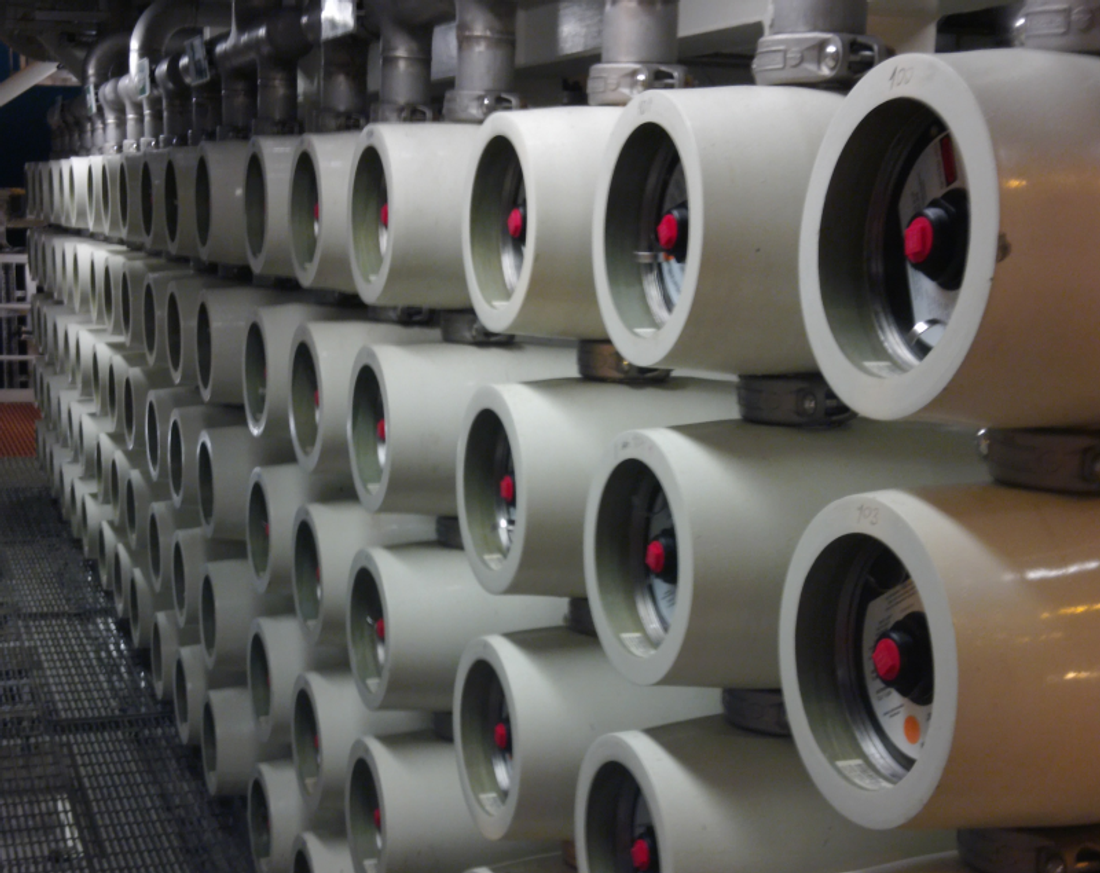
Most sulphate removal units can cut biocide consumption substantially before anyone changes chemical. The first step is to dose what the membranes need, and to measure whether each treatment worked.
Sulphate removal membranes need regular biocide treatment to keep biofilm under control. The common choice offshore is a DBNPA-based biocide, which is among the most environmentally problematic chemicals in seawater treatment. Every dose that passes through the membranes ends up in the sea, and operators are increasingly asked to reduce that discharge or remove it altogether.
The natural reaction is to look for a greener chemical. That is worth doing, but it is rarely where the largest reduction lies.
Why sulphate removal membranes need biocide
Seawater carries bacteria and organic matter that settle on the membrane surface and grow into biofilm. Biofilm raises the pressure drop across the membranes, increases pumping energy and shortens membrane life. Biocide treatment keeps that growth in check.
The need is not constant through the year. In the North Sea, biological growth peaks in February to March and again in August to September. Demand also rises when the systems upstream underperform: when coarse filters or ultrafiltration let more through, or when chlorination of the feed water is reduced and growth starts in the piping before the membranes.
A dosing regime set once at commissioning and left unchanged will therefore be too low in some months and too high in most others.
Most plants dose more than they need
Operational data from sulphate removal units suggests that most operators exceed the recommended biocide dosage. They treat more often, at higher concentrations and for longer than necessary.
There is a sensible reason for this. Overdosing does no harm to the membranes, so extra biocide feels like cheap insurance against fouling. The cost is carried elsewhere: in chemical purchases, in logistics offshore, and in what is discharged to sea.
For reference, a typical recommendation for a 20% DBNPA product is a minimum of 50 ppm for one hour each week, increased when seawater quality drops. Initial data from a North Sea seawater treatment system shows a potential 30 to 50% reduction in chemical consumption simply by following recommended dosing. This is consistent with what we have seen across several seawater treatment systems.
“A potential 30 to 50% reduction in chemical consumption simply by following recommended dosing”.
How to tell whether a treatment worked
Dosing less is only safe if you can see the effect of each treatment. Three indicators do most of the work:
- Fouling factor: Tracks fouling between the feed and permeate sides of the membranes.
- Normalised differential pressure, stage 1: The pressure drop from feed to concentrate across the first stage.
- Normalised differential pressure, stage 2: The same measure across the second stage.
Normalised means the readings are corrected for temperature and flow. Raw pressure moves with seawater temperature and production rate, which can hide a real change in membrane condition or create a false one. Once normalised, a treatment that has worked shows as a flattening or reversal of the trend.
With these indicators in place, three treatment settings can be adjusted with confidence: the dose concentration, the duration of each treatment and how often it is repeated. Each adjustment should take account of the season and of how well the upstream filtration and chlorination are performing.
If you do change chemical
Once dosing is under control, a change of chemical can take discharge further. The main options differ less in how well they kill bacteria than in what they do to the biofilm itself.
BIOCIDE | HOW IT ACTS | ACCEPTED BY MEMBRANE SUPPLIERS | TRADE-OFF |
|---|---|---|---|
DBNPA-based | Fast-acting; kills organisms on the biofilm surface but removes little of the film | Yes | Environmentally problematic; biofilm underneath survives |
Glutaraldehyde | Broad biocide | Yes | Reduces membrane permeability, partly restored by cleaning |
THPS | Milder, more environmentally acceptable | Yes | Also reduces permeability, partly restored by cleaning |
Stabilised chlorine products | Penetrate and peel biofilm off the membrane | Yes, for polyamide membranes | Limited offshore experience on sulphate removal units so far |
The newer stabilized chlorine products are the most interesting development. Because they remove biofilm rather than only killing its surface, they can keep membrane permeability higher for longer. Their results so far come mainly from reverse osmosis plants, which share the same seawater source and fouling problem, but direct experience on sulphate removal units is still limited.
A change of chemical also has practical consequences offshore. Some products must be stored between 5 and 25 °C, which means insulated and heat-traced tanks and tubing. Higher daily consumption may require larger storage. Dosing pumps can often be reused.
Treating one train at a time
Another way to cut chemical use is to treat one membrane train offline at reduced flow, instead of dosing the whole plant online. The train is run down to around one tenth of its normal feed flow, treated, and returned to service before the next train is treated.
This needs some preparation:
- A biocide injection point on each train, downstream of its inlet control valve.
- Automated sequences for rundown, treatment and start-up, typically adding 30 minutes each way per train.
- Control logic that lets downstream systems, including the injection wells, handle the change in flow.
Using the plant's clean-in-place system for biocide treatment can look like an easier route. In practice it is often ruled out by different pressure classes on the membrane and cleaning sides, limited fresh water and cleaning tanks that are too small.
We have run trains at reduced flow on several projects, mostly when injection demand did not require every train. We have not yet measured the long-term effect of biocide treatment at low flow, and neither have the chemical or membrane suppliers we have consulted. It is a promising option, but one to introduce with monitoring in place.